In the spotlight today is Seedsight, a pioneering company transforming the agri-food sector. Operating at the critical intersection of technology and food security, Seedsight curates a digital repository of seed and grain signatures, validated through biophysical analysis and powered by AI. Their platform empowers operators along the cereal value chain to minimize risk, maximize yield, and drastically reduce food waste.
Join us as we welcome Joana Paiva (JP), Seedsight CEO & Founder, to share the story behind this deep-tech innovation.
3xP: To start, could you please introduce yourself and share the story behind the creation of Seedsight? What was the original inspiration?
JP: My background is in biophysics and AI, and I spent years working in deeptech startups and at INESC TEC doing research on optical sensing technologies while doing my PhD. The seed of Seedsight came from a conversation with Gonçalo Ramos, who is now our Chief Commercial Officer. He had a decade of experience in agri-food and commodities trading, and he challenged me to look at what I was doing in the lab and whether it could solve a real problem he was seeing every day in the milling industry with the sector being essentially flying blind, due to the inability to rapidly and affordably assess cereal grain quality and predict flour extraction rates.
That question stuck with me. I invited Paulo our CTO, bringing deep photonics and engineering expertise, to go back to the lab and we started exploring whether this optical sensing approach, which was already producing promising results in biomedical contexts, could be applied to cereal grains. It turned out it could. Paulo Santos allowed us to translate what existed in a research environment into something that could actually work at industrial scale!
The three of us, each coming from a different angle, formed the founding team with a shared conviction that this technology could genuinely change how the agri-food sector operates. Today, with a team of ten people and active pilots running across Europe, it feels like we are just at the beginning of what this platform can do.
3xP: In the global agri-food sector, food security and supply chain efficiency are more critical than ever. What is Seedsight’s mission, and what primary problem are you aiming to solve in the market?
JP: Seedsight's mission is to make cereals safer, fairer, and more sustainable for everyone throughout the value chain, from the farmer in the field to the consumer at the table. We do that by giving the cereal industry something it has never had before: real-time, affordable, and comprehensive grain quality intelligence at the point of decision.
The problem we are solving is both simpler and more serious than most people outside the industry realise. As a simple example, today, when a miller receives a shipment of wheat or maize, the standard quality control process involves sending samples to an external laboratory and waiting days for results (for some specific analysis), at a cost of over €300 per test. During that time, production either halts or continues blind. If contamination or quality issues are discovered late, the consequences ripple across the entire supply chain: rejected shipments, wasted food, financial losses, and in the worst cases, cereals with dangerous levels of mycotoxins or heavy metals reaching the final consumer undetected.
The numbers behind this problem are staggering. Between 100 and 360 million tons of maize are wasted annually due to contamination alone. Additionally, 29% of traded wheat contains mycotoxins. On top of that, milling companies lose roughly 15% of flour extraction efficiency simply because they have no way to predict, before milling begins, how a given batch of grain will perform.
Seedsight's platform addresses all of this with a single scan. Our fiber-optic sensor, combined with proprietary AI, analyses a grain sample in some minutes and delivers multiparameter results, covering contaminant detection, traceability, flour extraction prediction, and flour quality/rheology prediction. What used to cost hundreds of euros and days now costs a fraction of that and delivers answers in real time, on site.
3xP: How does Seedsight’s platform drive sustainability and positive ESG impact in agriculture?
JP: Sustainability is not a layer we added on top of Seedsight. It is built into the core of what the technology does, because the problem we are solving is fundamentally a problem of waste: wasted grain, wasted energy, wasted food, and wasted potential across the entire cereal value chain.
On the environmental side, our impact starts with food loss prevention. By enabling real-time contaminant screening at the point of intake, we help prevent that waste before it occurs. At the milling stage, our flour extraction prediction capability recovers 30,000 to 50,000 additional tons of flour per million tons produced, which is efficiency that previously simply disappeared. And by reducing the rate of rejected cereal shipments, we directly cut CO2 emissions: each rejected vessel emits approximately 50,000 tons of CO2, and at scale, our impact targets a reduction equivalent to 15% of Ukraine war annual emissions. We also target a 10% annual reduction in energy consumption per milling plant.
On the health and social side, the platform detects mycotoxins before these substances ever reach the food supply. We also address a deep trade inequity: cereals from low-income countries are systematically priced 10 to 20% below equivalents simply due to perceived quality stigma. Objective, data-driven quality assessment removes that stigma and empowers small holder farmers to compete fairly inglobal markets.
Beyond our technology, we have formalised our social commitment through the youth development, which provides annual scholarships and training specifically for women and youth in digital agriculture, with a target of reaching 1,000 community members and training 300 farmers across Europe by 2028.
We are formally aligned with UN SDGs 2, 3, 12, and 13, and with the EU Farm to Fork strategy. But more than alignment, these goals describe outcomes we are actively engineering the platform to achieve.
.jpeg)
3xP: What are some of the key milestones or technological achievements that the Seedsight team has reached so far that you are most proud of?
JP: There are several milestones I am particularly proud of, because each one represented a moment where what we believed was possible became something we could prove.
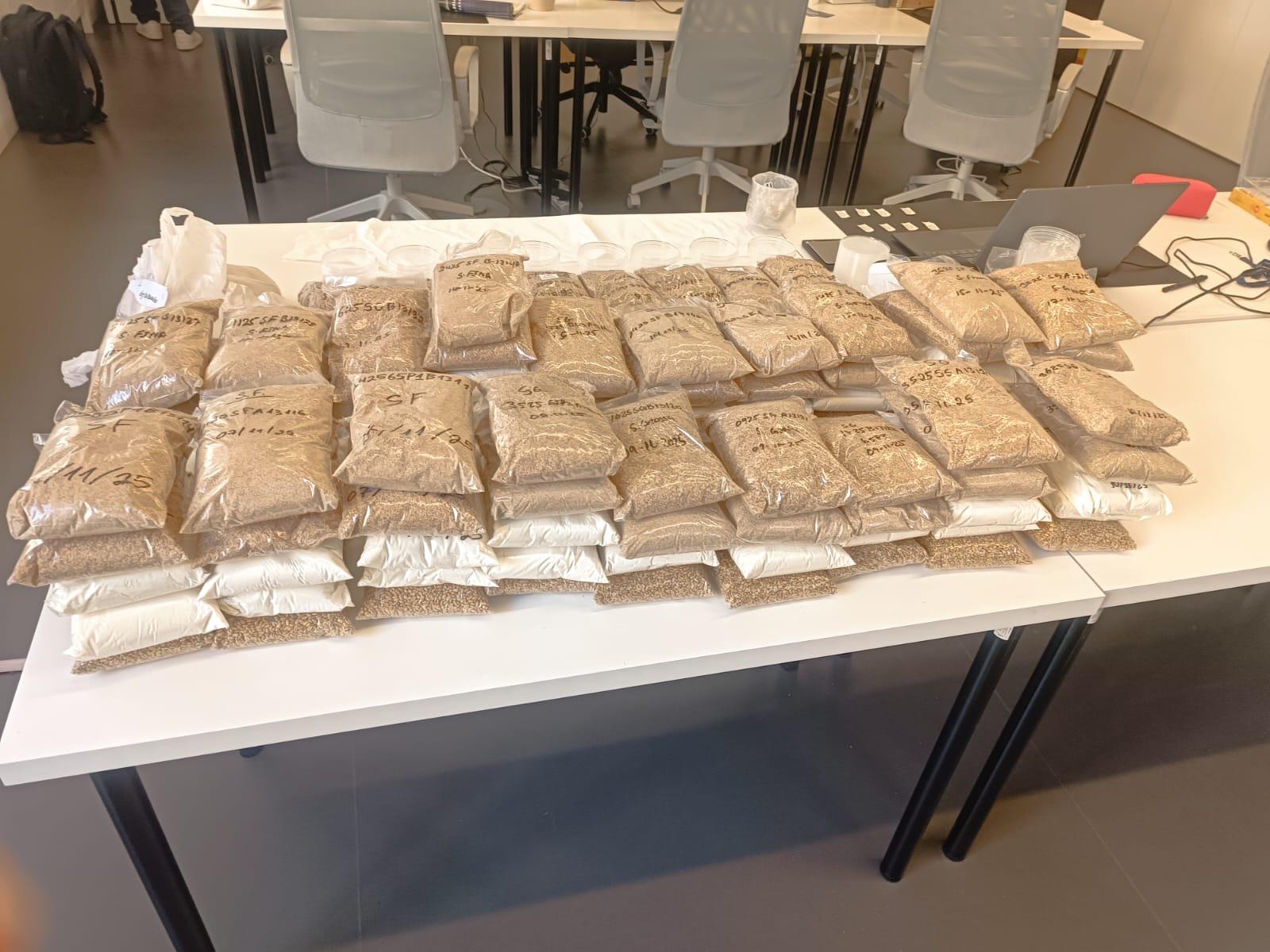
The first is the technology itself. Building a platform that can generate a fingerprint of a cereal grain in some minutes, across more than 100 parameters, using afiber-optic probe and proprietary AI, was not a given. It required years of research, a deep understanding of the technology and an enormous effort to train our models on a dataset that now holds over 1,000 grain signatures collected across 5 countries. That data set is one of our most valuable assets and building it through real industrial pilots rather than in a controlled lab environment is something I consider a genuine achievement.
The second is our IP position. We have been granted patents in the US, Japan, Australia,and Europe, with additional filings pending.
The third is the commercial validation we have earned. We launched MVP 1.0 in September 2025 and rapidly progressed to 4 active industrial pilots with leading millers and traders in Europe that we are currently in active negotiations to become paid clients. Simultaneously, we are close to reaching our goal of 3 pilots with leading agricultural cooperatives.
A fourth milestone is the completion of an internal audit for ISO 9001 and HACCP certification with non-compliances registered, and we are on track for the external audit in mid-August, which would make us one of the few platforms a tour stage to hold formal food safety certification.
Finally, the external recognition, with over 7 international awards, including the 2025 Altice Innovation Award, the Alibaba Jumpstarter Top 2025, and a nomination as a Hello Tomorrow Deep Tech Pioneer, along with being a finalist for the Nature Spinoff Prize, have validated that the broader scientific and entrepreneurial community sees what we are building as genuinely important.
.jpeg)
3xP: How do you see the partnership with 3xP Global helping Seedsight accelerate its growth, expand its digital repository, and achieve its long-term goals?
JP: 3xP Global has been more than a financial backer since leading our Pre-Seed round. What has stood out most is the quality of the advisory relationship. The 3xP team has been consistently present, helping us think through the right direction at critical decision points rather than simply monitoring from KPIs.
That kind of engaged, hands-on support matters enormously when navigating the transition from a research-stage technology to an industrially validated platform. There are moments where the path forward is not obvious, and having a partner that helps to stress-test the assumptions, adds real value that goes well beyond capital.
As we move toward by converting active pilots into long-term contracts, the foundation that 3xP Global helped us build, both financially and strategically, positions us to execute the next phases with much greater confidence. We see this as along-term partnership, and we are genuinely grateful to be part of their portfolio.
3xP: What is your ultimate goal for the global food supply chain?
JP: Our ultimate goal is to make grain quality intelligence a universal standard across the global food supply chain. Today, the decisions that determine whether food is safe, whether a farmer is paid fairly, and whether a milling plant operates efficiently are made with incomplete, slow, and expensive information. We want to change that permanently.
In practical terms, that means a world where every cereal shipment, regardless of where it originates or where it is going, can be screened in real time, onsite, and at a cost that makes comprehensive quality analysis accessible to the entire value chain, not just the largest industrial players. Small holder farmers in low-income countries should have access to the same quality intelligence as the biggest millers in Europe. That data-driven transparency is what creates fairer trade, safer food, and more resilient supply chains.
Beyond cereals, we see this platform expanding into adjacent commodities: rice, barley, oats, coffee, and olive oil. The underlying technology is agnostic, and the same biomolecular fingerprinting approach that works for wheat and maize can be adapted to other crops where the same systemic failures in quality control exist.
At the deepest level, what we are building is a data infrastructure for the food system. Every scan enriches our dataset, every new market we enter adds to the intelligence of the platform, and over time, Seedsight becomes not just a quality testing tool but the global reference standard for how the world understands, values, and trades grains. That is the future we are working toward.
3xP: To end, if you could give one piece of advice to an aspiring entrepreneur looking to build an impact-driven tech startup, what would it be?
JP: The one piece of advice I would give is to fall in love with the problem, not with your solution. Impact-driven startups are particularly vulnerable to the opposite trap, where the mission becomes the product and the genuine problem gets obscured by the narrative around it. The most important discipline to practice, especially in the early stages, is to stay relentlessly close to the people who have or had the problem by talking to them constantly. This leads to reality challenging the assumptions.
Thank you so much, Joana, for sharing your story and insights. We’re excited to see what’s next. Stay tuned for more insights in the 3xP Global Spotlight Series.
For more inspiring stories and updates on how 3xP Global is supporting startups like Goparity, Kinetikos Health, La Bolsa Social, PeekMed, Leadzai, Mútua Saúde, SiosLife, Mezze or LoopOS.
Follow us on LinkedIn and explore our website.